
Executive Summary for Law Firm Leadership: True AI transformation in law firms is not a software rollout; it is an overhaul of the firm’s operating engine. While 85% of firms remain trapped in “pilot purgatory” paying for individual chatbot licenses, market leaders treat artificial intelligence as production infrastructure. Real transformation requires three structural pivots: replacing manual associate tasks with agentic workflows connected directly to your document management system (DMS); abandoning the self-defeating billable hour in favor of value-based pricing that captures the “tech dividend”; and transforming decades of archived work product into a proprietary data moat that compounds institutional intelligence over time. Our corporate governance and advisory practice regularly guides legal and enterprise leaders through this operational evolution.
The $650-an-Hour Paradox: When 15 Hours Compresses to 12 Minutes
In late 2025, a premier corporate law firm was retained by a multinational private equity client to handle commercial contract diligence for a $140 million cross-border acquisition.
Following traditional firm workflow, a senior partner assigned two mid-level associates to review a virtual data room containing 280 commercial supply agreements, intellectual property assignments, and cross-guarantee instruments. Working across a weekend, the associates logged 72 billable hours at $650 per hour to analyze change-of-control triggers, uncapped liability clauses, and assignment covenants. The resulting line item on the interim billing statement totaled $46,800.
On Tuesday morning, the client’s General Counsel summoned the relationship partner to an immediate videoconference.
The General Counsel had not disputed the accuracy of the review. Instead, she shared her screen. Her internal legal operations team had run the same data room through an enterprise-governed agentic pipeline anchored by specialized legal configurations of Claude and Harvey. In exactly 12 minutes and 40 seconds, the system had extracted every non-standard indemnification clause, cross-referenced the change-of-control thresholds against the company’s negotiation playbook, flagged six undisclosed liabilities, and produced an auditable redline with pinpoint page citations. The compute cost: $14.20.
The General Counsel struck the $46,800 charge from the invoice with a single directive:
“We hire your firm for your partners’ judgment, regulatory leverage, and tactical deal structuring. We will never again pay for junior associates to manually read contracts that software can parse before our morning coffee.”
This encounter illustrates the defining crisis of modern legal practice. According to research from the Harvard Law School Center on the Legal Profession, corporate legal departments are aggressively adopting generative tools to insource routine analysis and audit outside legal spending. The traditional law firm business model was constructed on monetizing associate time. Generative AI destroys the commercial logic of that time.
Firms that simply purchase AI licenses while preserving the billable hour are participating in an economic race to the bottom: the faster and more efficient their lawyers become, the less revenue the firm collects. To survive and expand margins, partnerships must understand what AI transformation in law firms actually entails.
The Operational Diagnostic: Escaping Law Firm “Pilot Purgatory”
In evaluating legal practice operations across the market, our advisory team observes a recurring structural failure: law firms consistently confuse individual employee assistance with institutional production infrastructure.
Most law firms are currently stalled in what we diagnose as “Pilot Purgatory.” A firm purchases 500 enterprise seats of an AI copilot, issues a cautious acceptable-use memo, and conducts an optional lunch-and-learn. Individual associates use the tool to draft emails, summarize deposition transcripts, or brainstorm discovery interrogatories.
While individual lawyers may save 30 minutes a day, the firm itself has transformed nothing. When that associate logs off, the interaction vanishes. The firm’s operating margins remain unchanged, and its competitive positioning against peer firms remains identical.
| Level 1: Ad-Hoc Adoption (The Toy Phase) | Level 2: Production Infrastructure (True Transformation) |
|---|---|
| Individual chatbot windows and ad-hoc prompts | Autonomous, multi-step agentic pipelines |
| Ephemeral, stateless chat sessions | Persistent institutional memory and knowledge graphs |
| Manual copy-pasting between browser and Word | Native DMS (iManage, NetDocuments) integration |
| Billed by the hour (destroying margin) | Value-based, fixed-fee alternative fee arrangements |
| Black-box outputs without verification | Inspectable surfaces and source-grounded citations |
To move from cosmetic adoption to genuine transformation, law firm leadership must implement four foundational architecture principles across their practice groups:
- From “Assistants” to “Production Infrastructure”: An assistant waits for a human prompt. Production infrastructure executes business logic automatically. In a transformed firm, AI is not an isolated browser tab; it is an active engine integrated directly into the matter intake pipeline. When a new lawsuit is filed or an NDA arrives via email, the system automatically parses jurisdiction, checks conflict databases, executes initial risk triage, and populates the matter file in your document management system before a human attorney even opens the folder.
- Accumulating Institutional Intelligence: Foundation large language models are stateless: they know what the public internet knows, but they know nothing about how your firm negotiates. True enterprise advantage comes from systematically accumulating institutional intelligence. Every settlement reached, every fallback clause drafted by your senior corporate partners, and every judge-specific procedural strategy must be structured and indexed. A transformed firm does not prompt a generic model; it prompts a model grounded in twenty years of its own hard-won precedents.
- Inspectable Surfaces and Auditable Workflows: In a courtroom or a high-stakes M&A negotiation, an unverified AI generation is legal malpractice. Black-box outputs are inadmissible in elite practice. Transformation requires inspectable surfaces: user interfaces where the model’s underlying chain of reasoning, statutory citations, and contract clause coordinates are displayed side-by-side with the output. The lawyer acts as an auditor and guarantor of accuracy, verifying traceable links back to primary source materials before client submission.
- The Meta-Competency of Legal Orchestration: As generative models compress the time required for research, drafting, and document analysis from days to minutes, professional roles converge. The defining skill of the modern lawyer is orchestration: the ability to decompose a complex commercial objective into discrete agentic tasks, evaluate outputs critically, and synthesize high-level legal strategy. Law firms must stop training associates to be document scriveners and begin training them as legal system orchestrators.
The 2026 Tech Landscape: Claude vs. OpenAI vs. Google AI in Legal
The legal technology market underwent a decisive shift in 2026. The major AI research labs moved beyond general enterprise software to release specialized, legally governed platforms designed to integrate directly with firm infrastructure.
| Architectural Dimension | Anthropic: Claude for Legal | OpenAI: Astra for Law & Harvey | Google: Gemini Enterprise for Legal |
|---|---|---|---|
| Primary Technical Advantage | Model Context Protocol (MCP) connectors linking directly to iManage, NetDocuments, Relativity, and Microsoft 365. | Agentic Workflow Engine and multi-agent reasoning vaults developed in close partnership with legal platforms like Harvey. | Google Cloud Vertex AI infrastructure with 2M+ Token Context Window for full-corpus discovery and entire M&A data room ingestion. |
| Tone & Drafting Precision | Nuanced, precise, and naturally calibrated legal prose; exceptional adherence to strict negative drafting constraints. | Highly structured, decisive logic; exceptional at rapid cross-disciplinary synthesis and multi-jurisdictional statutory mapping. | Native integration with Google Workspace (Docs, Sheets) with direct grounding against verified precedent databases. |
| Notable Deployments | Quinn Emanuel, Freshfields, Holland & Knight; foundational engine behind Robin AI. | Global firm-wide deployment at A&O Shearman (3,500+ lawyers across 43 offices); OpenAI Enterprise at Willkie Farr. | Cleary Gottlieb, Freshfields, Weil, Gotshal & Manges, Williams & Connolly. |
| Ideal Law Firm Workloads | Complex contract negotiation, regulatory comment letters, appellate brief drafting. | Multi-tier transactional diligence, automated deal closing checklists, structured discovery interrogatories. | Massive multi-volume e-discovery litigation, full virtual data room lease analysis, antitrust merger filings. |
| Privilege & Data Isolation | Zero-retention enterprise SLAs; customer data strictly excluded from model retraining; SOC 2 Type II certified. | Dedicated enterprise instances with contractual zero-training clauses and comprehensive compliance logging. | Vertex AI private tenancy; Customer-Managed Encryption Keys (CMEK); guaranteed tenant isolation and ethical walls. |
Choosing an underlying model is no longer about raw benchmark scores. It is about architectural interoperability: how cleanly does the model connect to your existing matter management software, how strictly does it honor ethical walls, and how effectively can it be grounded in your firm’s historical work product?
The 5 Pillars of Real Law Firm AI Transformation
Pillar 1: Workflow Architecture: From Prompting to Agentic Automation
The first pillar of transformation requires dismantling the misconception that lawyers should spend their day typing prompts into a text box. Ad-hoc prompting is human-dependent, unstandardized, and prone to user error.
Transformed law firms build deterministic agentic pipelines. In our commercial contract drafting practice, we implement structured pipelines where an incoming contract is automatically parsed by an intake agent into discrete operative sections, evaluated against established fallback clauses, and redlined directly in Microsoft Word with Track Changes enabled. The supervising attorney reviews an executive risk summary and the redlined document side-by-side, verifying changes in minutes rather than drafting boilerplate from scratch.
Pillar 2: The Economic Engine: Capturing the “Tech Dividend”
For over a century, the economic engine of commercial law has rested on the billable hour. Time-based billing created an unfortunate structural alignment: firm revenues expanded as efficiency decreased. Generative AI breaks this economic relationship. As detailed by analysis from the Thomson Reuters Institute, if an automated diligence engine compresses a 20-hour contract review into 20 minutes, an hourly billing model slashes firm revenue by 98%.
Market leaders recognize that AI transformation requires a complete restructuring of their billing model to capture the Tech Dividend, representing the economic spread between the value delivered to the client and the near-zero marginal cost of computational execution.
- Traditional Hourly Billing: 20 Associate Hours @ $600/hr = $12,000 Client Cost. Firm Profit Margin: ~40% = $4,800.
- Untransformed Firm Using AI (Hourly Pricing): 0.5 Associate Hours @ $600/hr = $300 Client Cost + $20 Software = $320 Billed. Partner Profit: $128 (a 97.3% revenue collapse).
- Transformed Firm (Value-Based Fixed Pricing): Agreed Fixed Fee for Expedited Diligence: $6,500 (Client saves $5,500 vs. market rate). Cost of Delivery: 0.5 Associate Hours ($150) + AI Compute ($20) = $170. Firm Profit Margin: ~97% = $6,330 Partner Profit (+31.8% increase in absolute profit).
By transitioning to Alternative Fee Arrangements (AFAs), such as fixed-fee diligence packages, monthly advisory retainers under our corporate governance frameworks, and outcome-indexed fees, the firm decouples revenue from time. The client receives faster turnaround times and budget certainty; the firm increases its margins by monetizing technological efficiency rather than human fatigue.
Pillar 3: Talent Architecture: From the “Pyramid” to the “Obelisk”
Since the early 1900s, commercial firms have utilized the traditional leverage model: a wide base of junior associates billed at high hourly rates to generate surplus profits for a small tier of equity partners. AI fundamentally narrows the base of that pyramid. When junior associates are no longer needed to spend 80 hours a week reading PDFs in windowless conference rooms, the traditional staffing ratio collapses into what industry analysts call the “Obelisk” or the “Diamond.”
This structural shift introduces a profound organizational dilemma: The Junior Training Paradox. If an AI agent performs all initial drafting and diligence, how do first-year lawyers develop the professional intuition and legal judgment required to advise clients a decade later?
Leading firms are solving this challenge through overhauled talent development and retention frameworks: transitioning associates from scriveners to auditors from Day 1, running simulated practice labs through internal LLM environments to compress years of negotiation pattern recognition into structured modules, and immersing junior associates directly into client strategy sessions.
Pillar 4: The Proprietary Data Moat
Every law firm has access to the same commercial AI models. A subscription to Claude, OpenAI, or Gemini does not confer a defensible competitive advantage. The only sustainable differentiator for a law firm in the AI era is its proprietary data asset.
Most law firms sit on an unmined gold reserve: millions of documents stored across iManage or NetDocuments representing decades of legal ingenuity. Transformed law firms clean, tag, and sanitize their historical work product, stripping client identifiers while preserving legal logic, negotiation histories, and drafting notes. They build custom retrieval-augmented generation (RAG) graphs. When a partner prepares a dispute strategy, our commercial dispute resolution practice utilizes agents grounded in our own settled matters, judicial precedent databases, and procedural filings to construct pleadings tailored to specific court jurisdictions.
Pillar 5: Privilege, Risk & Client Outside Counsel Guidelines (OCGs)
Lawyers operate under strict ethical canons: the ABA Model Rule 1.1 (Duty of Competence), which requires lawyers to keep abreast of the benefits and risks associated with relevant technology, and the ABA Model Rule 1.6 (Duty of Confidentiality). In 2026, two legal developments heightened the stakes for law firm AI governance:
First, landmark federal jurisprudence in United States v. Heppner (2026) established that while entering privileged client facts into properly governed, zero-retention enterprise systems does not automatically waive privilege, inputting confidential client data into consumer-grade or unvetted cloud tools that retain data for training constitutes a reckless disclosure, resulting in a complete waiver of the attorney-client privilege.
Second, Fortune 500 GCs routinely update their Outside Counsel Guidelines with stringent AI provisions: mandatory prohibitions on unvetted consumer tools, auditability mandates requiring outside counsel to certify prompt chains, and explicit prohibitions against billing hourly rates for automatable tasks. Establishing proactive statutory regulatory compliance audits is essential for firms to maintain institutional trust.
The 5-Phase AI Transformation Roadmap for Managing Partners
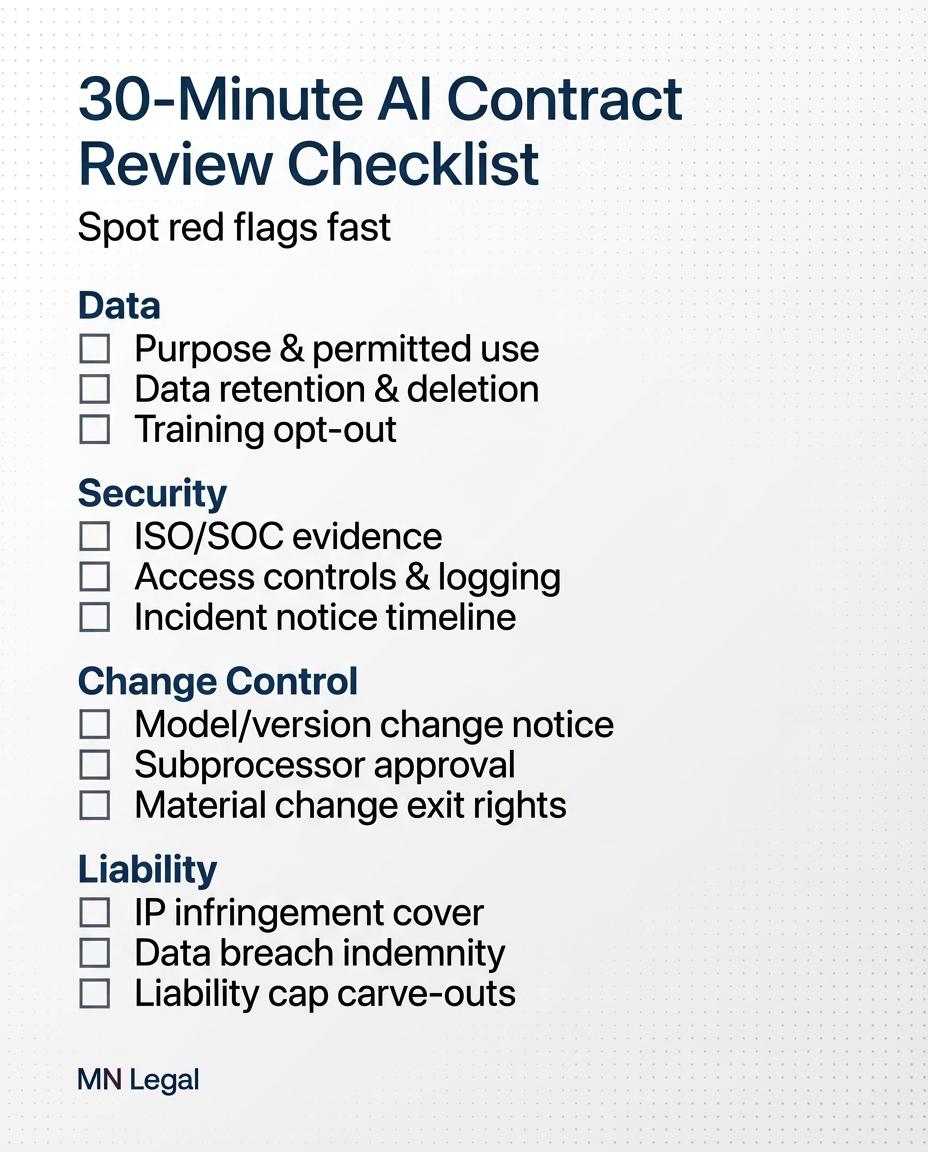
- Phase 1: Governance & Security Audit (Days 1 to 60): Block consumer AI tools across all firm networks and endpoints. Deploy enterprise-grade foundational environments with zero-data-retention guarantees. Audit client Outside Counsel Guidelines (OCGs) for AI compliance obligations.
- Phase 2: High-Volume Workflow Discovery (Days 61 to 120): Map high-frequency, repetitive associate tasks across your top practice groups. Identify beachhead workflows: NDA triage, lease abstraction, litigation timelines. Benchmark current baseline costs, turnaround times, and realization rates.
- Phase 3: Agentic Infrastructure Deployment (Days 121 to 240): Connect foundational models to your DMS via secure API connectors. Build inspectable, redlining agent pipelines with human-in-the-loop audit gates. Mandate firm-wide certification programs on legal orchestration and output auditing.
- Phase 4: Business Model & Billing Realignment (Days 241 to 360): Introduce fixed-fee and value-based pricing for automated workflow deliverables. Adjust associate performance metrics to reward efficiency, innovation, and client value. Package proprietary automated review workflows into client-facing advisory products.
- Phase 5: Proprietary Knowledge Asset Capitalization (Year 2 and Beyond): Clean, structure, and vectorize the firm’s decades of historical precedent documents. Deploy proprietary practice-specific models grounded exclusively in firm IP. Establish a permanent technology innovation dividend in partner compensation metrics.
Frequently Asked Questions
What is the difference between AI adoption and AI transformation in a law firm?
AI adoption is tactical and tool-centric: buying licenses for an AI assistant and letting lawyers use it voluntarily for individual drafting or summarization. AI transformation is strategic and systemic: re-architecting the firm’s core workflows into automated agentic pipelines, realigning pricing away from the billable hour toward value-based fees, revamping junior talent development, and structuring the firm’s precedent repository into a proprietary data moat.
Will AI eliminate junior lawyers at law firms?
No, but it will fundamentally change what junior lawyers do. The demand for associates who spend thousands of hours manually proofreading, cross-referencing citations, or summarizing contracts will decline precipitously. However, firms will actively compete for junior lawyers who excel at orchestration: lawyers who can operate multi-agent systems, critically audit AI-generated legal reasoning, spot commercial risk, and communicate complex strategy directly to clients early in their careers.
How do law firms maintain attorney-client privilege when using generative AI?
Firms must utilize enterprise-grade deployments with strict contractual guarantees that customer inputs are neither retained nor used to train foundation models. According to emerging 2026 case law (such as United States v. Heppner), feeding confidential client data into public, consumer-grade models constitutes a reckless waiver of privilege. Enterprise systems deploying dedicated virtual private clouds, customer-managed encryption keys, and zero-retention policies protect work product and maintain the attorney-client privilege.
How can a law firm transition away from the billable hour without losing revenue?
By capturing the Tech Dividend. When a task that previously took 15 hours is executed in 15 minutes by an AI agent, billing by the hour destroys firm revenue. However, if the firm packages that deliverable as a fixed-fee service at a modest discount to historical rates, the client enjoys budget predictability and rapid delivery, while the firm achieves profit margins exceeding 90% on that workflow due to negligible marginal compute costs.
Final Directive: The Cost of Inaction
Law firm partnerships are inherently conservative institutions. For decades, legal leaders could comfortably wait for new technologies to mature before adopting them. Generative AI offers no such grace period. Because generative models learn and compound institutional intelligence over time, the competitive gap between firms operating automated agentic infrastructure and those relying on manual associate billable hours is widening exponentially.
Clients will not subsidize human inefficiency when software delivers higher precision in minutes. The firms that thrive over the next decade will not be those that boast the most lavish office leases or the largest associate pools. They will be the firms that view artificial intelligence not as a tool to automate yesterday’s tasks, but as the foundational architecture upon which tomorrow’s legal enterprise is built.
For strategic counsel on legal technology governance, corporate policy structuring, and compliance frameworks, contact our practice leaders at MN LAdvocates LLP or schedule an executive consultation. Explore more analysis in our legal innovation insights hub.