
Quick Summary for Employers: Establishing clear workplace policies in Kenya is the single most effective way to protect your business against catastrophic legal liability. Under the Employment Act, 2007 (Cap 226) and binding decisions of the Employment and Labour Relations Court (ELRC), dismissals fail when organisations lack documented, consistently enforced workplace rules. Without written disciplinary procedures, sexual harassment policies, or data governance frameworks, even justified terminations are routinely ruled procedurally unfair, exposing employers to compensation awards of up to 12 months’ gross salary per employee. Our employment and labour law practice regularly advises companies on closing these governance gaps.
The Ksh 4.2 Million Oversight: What Happens Without Workplace Policies in Kenya
In 2021, an expanding logistics firm based along Mombasa Road in Nairobi dismissed an operations supervisor. The employee had arrived over an hour late on four consecutive Mondays, leaving fleet drivers idle and delaying client deliveries across the country.
The Managing Director called him into the boardroom, pointed out the clear operational disruption, issued a termination letter citing gross insubordination, and paid him one month’s salary in lieu of notice alongside his accrued leave days.
To the Managing Director, the decision seemed practical, fair, and commercially obvious.
Six months later, the company stood before the Employment and Labour Relations Court (ELRC). The dismissed supervisor did not deny the lateness. Instead, his advocate raised three simple questions:
- Where is the company’s written attendance policy defining persistent lateness as gross misconduct warranting summary dismissal?
- Where is the record demonstrating the employee received, read, and signed an acknowledgement for that policy?
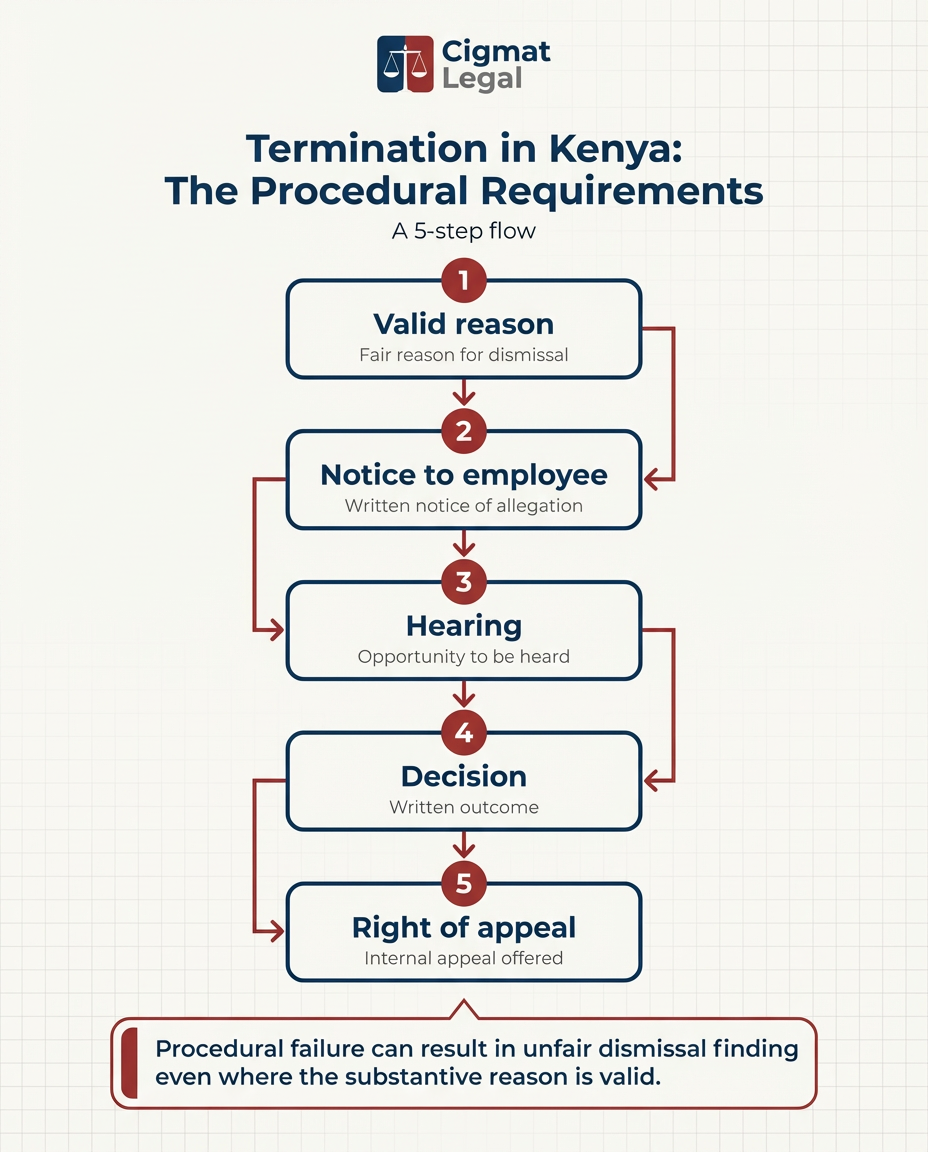
- Where is the written notice under Section 41 of the Employment Act inviting the employee to a hearing in the presence of a colleague of his choice before the decision was made?
The company had none of these. There was an individual employment contract, but no formal workplace policies in Kenya to govern workplace conduct. According to official judicial interpretations documented in Kenya Law Reports, the court ruled the termination substantively and procedurally unfair. The award: eight months’ gross pay in compensatory damages, unpaid overtime calculations, and legal costs totaling just over Ksh 4.2 million.
This was not a rogue employer acting in bad faith. It was a well-intentioned leadership team that failed to realize an employment contract cannot substitute for institutional workplace policies in Kenya.
Contracts vs. Workplace Policies in Kenya: Understanding the Difference
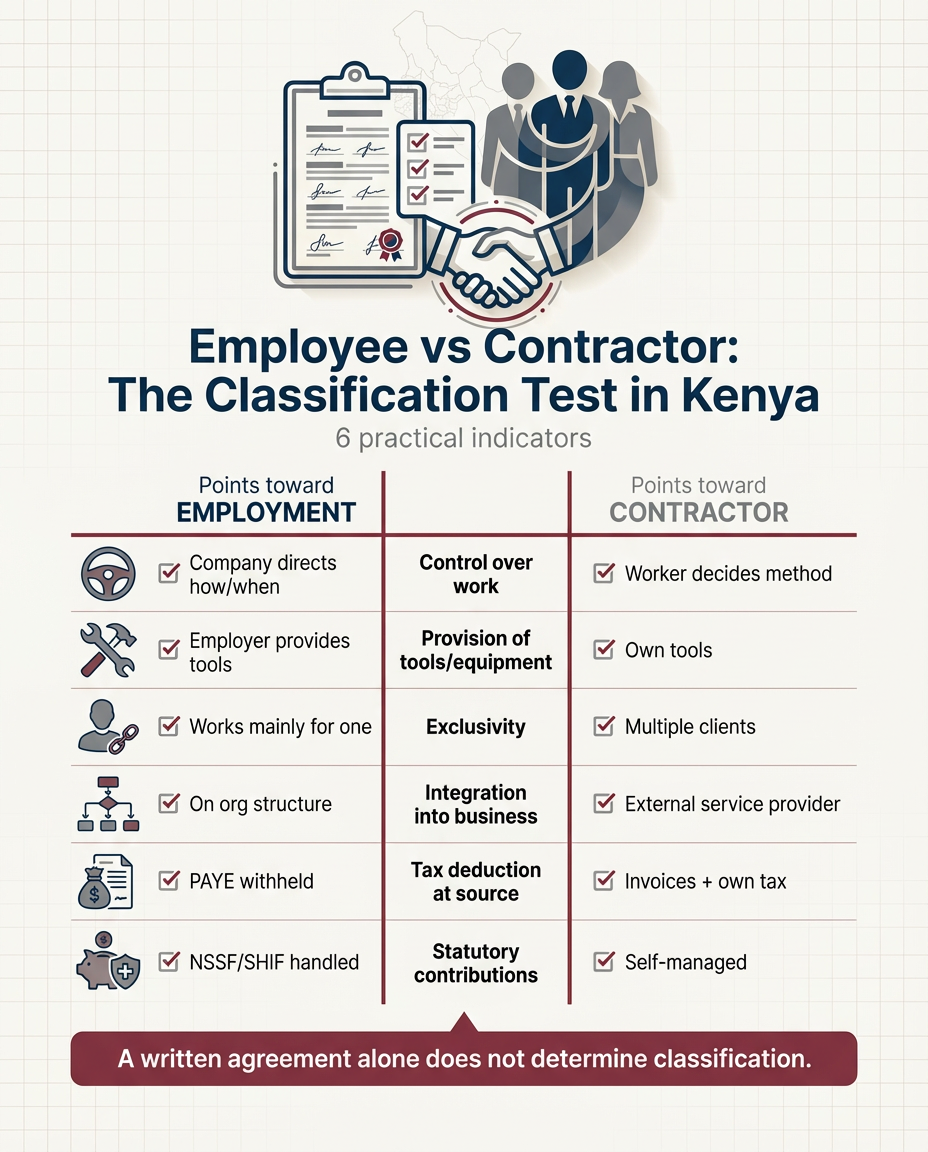
Every business operating locally begins by drafting standard employment contracts. These agreements define core deliverables, set probation periods, agree on remuneration, and specify statutory tax deductions.
However, an employment contract is an individual agreement between one employee and the firm. It answers: “What does this specific person do, and what are they paid?”
In contrast, effective workplace policies in Kenya govern the entire institution. They form the core of your corporate governance framework by providing standardized answers to critical operational dilemmas:
- How does the company investigate an allegation of sexual harassment between a senior director and an intern?
- What exact steps must a manager take before dismissing an underperforming sales executive?
- May an employee download proprietary customer databases to a personal laptop while working remotely?
- What occurs when an employee exhausts statutory sick leave during long-term medical recovery?
- What constitutes an unlawful conflict of interest when an employee operates an outside side-hustle?
When an organisation operates without documented rules, decisions are made arbitrarily by individual managers. Inconsistency is the primary trigger for employment litigation. If one supervisor overlooks unpunctuality while another terminates an employee for the same offence, the company faces exposure under Article 41 of the Constitution of Kenya (Fair Labour Practices) and Section 5 of the Employment Act.
| Employment Contract (Individual) | Workplace Policies in Kenya (Institutional) |
|---|---|
| Job title and direct reporting line | Section 41 fair hearing steps & notice timelines |
| Agreed basic salary, allowances & pay dates | Objective performance improvement plans (PIP) |
| Probation length and workplace location | Employee data privacy & device usage (DPA 2019) |
| Statutory annual leave baseline (21 days) | Sexual harassment reporting & non-retaliation rules |
| Contract termination notice period | Remote work, confidentiality & intellectual property |
Why Workplace Policies in Kenya Are a Statutory Requirement
Kenyan labour legislation does not treat human resource policies as optional administrative suggestions. In several critical areas, Parliament has made written policies an express statutory duty:
1. Section 41 Disciplinary Hearing Rules
Under Section 41 of the Employment Act, an employer must explain the reasons for an intended dismissal in a language the employee understands, grant an opportunity to respond, and permit a colleague or union representative to attend the hearing. Without documented workplace policies in Kenya, an employer cannot prove that a fair, uniform procedure was applied. Our team frequently provides commercial dispute resolution representation when procedural compliance is contested.
2. Mandatory Sexual Harassment Policy (20+ Staff)
Under Section 6(2) of the Employment Act, 2007, every enterprise employing 20 or more staff is legally mandated to implement and display a written policy statement against sexual harassment. The policy must define prohibited conduct, establish a secure grievance channel, and protect whistleblowers from retaliation.
3. Occupational Safety & Health Act (OSHA 2007)
Under Section 6 of OSHA, enforced by the Ministry of Labour and Social Protection (DOSHS), businesses with 20 or more workers must prepare and regularly revise a written statement of health and safety policy. Failure to maintain compliant safety standards exposes directors to statutory fines and civil liability.
4. Data Protection Act Compliance
Employee biometrics, CCTV surveillance recordings, payroll numbers, and emergency contact details are classified as personal data. Under guidelines issued by the Office of the Data Protection Commissioner (ODPC), employers must establish an Employee Privacy Notice and internal data management rules to avoid regulatory penalties of up to Ksh 5 million.
Substantive vs. Procedural Fairness in Kenyan Employment Disputes
The single most dangerous misconception among business owners is believing that a valid reason to dismiss an employee guarantees safety from lawsuits. Under Sections 43 and 45 of the Employment Act, Kenyan courts enforce a strict two-pronged test on every termination:
| Substantive Fairness (The “Why”) | Procedural Fairness (The “How”) |
|---|---|
| Did gross misconduct or theft actually happen? | Was a formal written show-cause letter issued? |
| Is poor performance objectively measured? | Did the worker receive at least 48 hours to prepare? |
| Is there a genuine operational redundancy? | Were they invited to bring a colleague or union rep? |
| Is there credible evidence on record? | Was an impartial hearing held before deciding? |
If an employer proves theft occurred (substantive justification) but dismissed the worker without a written show-cause letter or hearing (procedural failure), the court will deem the termination unlawful. Under Section 49, the ELRC can award up to 12 months’ gross salary in damages, plus notice pay, accrued leave, and legal costs. Conducting regular statutory regulatory compliance audits is the most reliable method to eliminate this risk.
5 Costly Mistakes Employers Make with Workplace Policies in Kenya
In our advisory practice at MNL Advocates LLP, we frequently identify five recurring compliance mistakes across growing businesses:
| Mistake | Operational Reality | Legal Exposure |
|---|---|---|
| 1. The Foreign Template | Copying a staff handbook from a UK, US, or South African branch without local adaptation. | Confers unwanted obligations or breaches mandatory Kenyan statutory minimums. |
| 2. The Unacknowledged Policy | Storing rules on an intranet or HR drive without signed acknowledgement forms. | Employees claim in court they never received the rule; uncommunicated policies cannot be enforced. |
| 3. Bypassing Process for ‘Obvious’ Cases | Terminating on the spot because an offence was caught on camera. | Violates Section 41, causing employers to lose cases on procedural grounds despite clear guilt. |
| 4. Forfeiting Statutory Rights | Attempting to draft clauses that forfeit statutory annual leave or reduce notice pay. | Section 3 renders any term falling below statutory minimums null and void. |
| 5. Outdated Handbooks | Using handbooks that do not reflect recent labour amendments. | Leaves companies non-compliant with SHIF deductions, Housing Levy requirements, and remote work privacy. |
What Comprehensive Workplace Policies in Kenya Must Contain
A robust organisational handbook tailored to Kenyan law should address twelve key chapters:
- Recruitment & Fair Hiring: Objective screening criteria, statutory background checks, and clear probation terms.
- Working Hours & Overtime: Standard statutory work week limitations, shift schedules, overtime compensation, and flexible working arrangements.
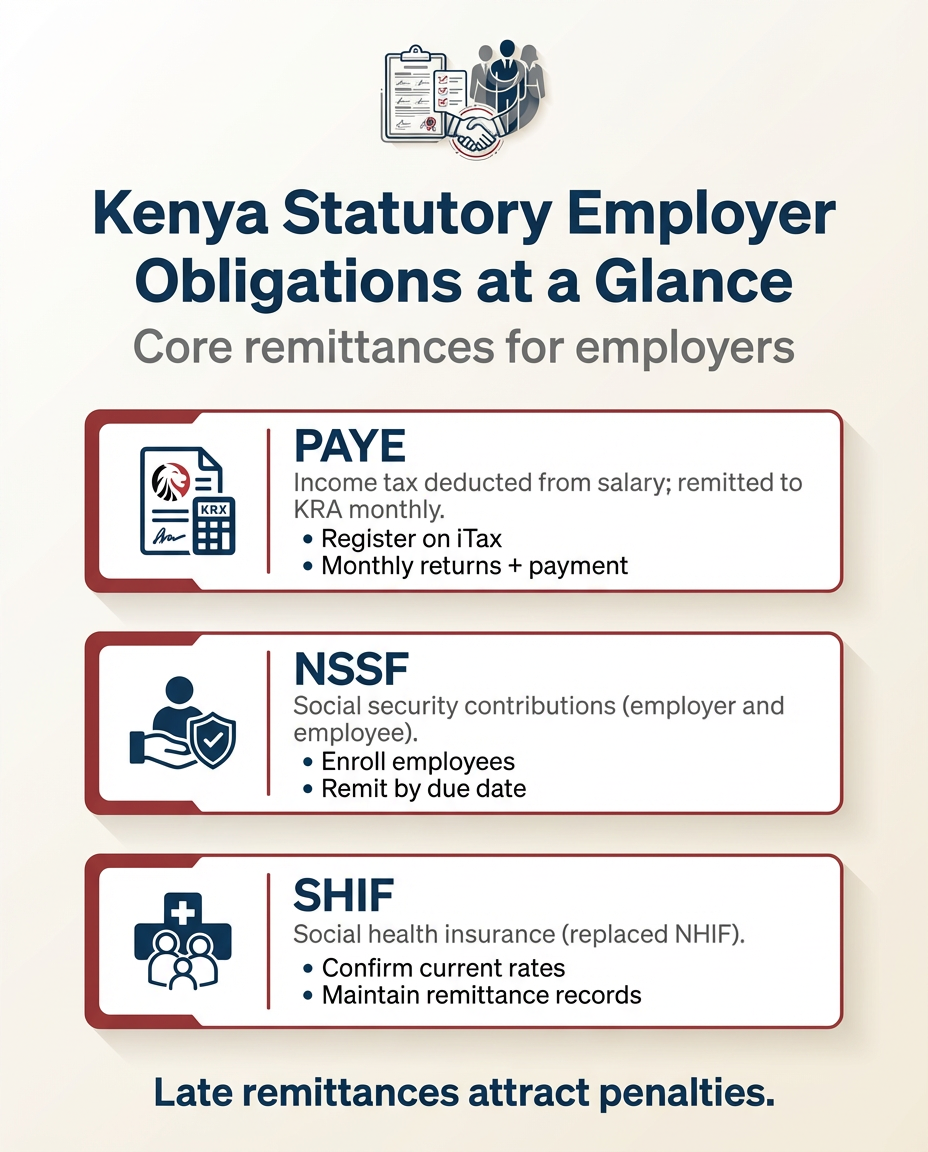
- Remuneration & Deductions: Regular pay cycles, statutory remittances (PAYE, NSSF, SHIF, Housing Levy), and strict limits on unlawful salary deductions.
- Statutory Leave Entitlements: Annual leave (minimum 21 working days), maternity leave (3 months fully paid), paternity leave (2 weeks), and sick leave rules.
- Anti-Harassment & Equal Opportunity: Strict sexual harassment definitions, anonymous reporting pathways, and anti-retaliation provisions.
- Health, Safety & Environment: Incident reporting protocols, fire safety, and compliance with OSHA 2007.
- Data Protection & Electronic Devices: Company email usage, device security (BYOD), CCTV monitoring, and privacy protections under the Data Protection Act, 2019.
- Code of Conduct & Ethics: Anti-bribery compliance, conflict of interest disclosures, and non-disclosure standards.
- Disciplinary Protocol: Classification of offences, show-cause procedures, and a standardized Section 41 hearing workflow.
- Internal Grievance Redressal: Clear escalation channels to resolve employee disputes internally before external mediation or litigation.
- Separation & Offboarding: Resignation procedures, redundancy protocols, handover checklists, and statutory certificates of service under Section 51.
- Policy Review Framework: A defined mechanism for annual reviews to adapt to statutory changes.
For organisations looking to standardize these chapters, our team specializes in bespoke employee handbook drafting tailored to your industry’s exact risk profile.
5-Minute Employer Compliance Checklist
Assess your current human resource framework against these seven critical benchmarks:
- Staff Sign-Off: Do you hold signed acknowledgement forms confirming 100% of employees have received the current staff handbook?
- Disciplinary Alignment: Does your policy mandate a written show-cause notice, a 48-hour preparation window, and the right to a companion before termination?
- Harassment Policy: If employing 20 or more workers, is your written sexual harassment policy visibly posted in the workplace?
- Data Protection Notice: Has your organisation issued an Employee Privacy Notice detailing the processing of employee personal and biometric data?
- Leave Floor Compliance: Does your leave policy guarantee the minimum 21 working days of annual leave without illegal forfeiture terms?
- Authorized Deductions: Are payroll deductions strictly confined to statutory deductions and employee-authorized written deductions?
- Regular Updates: Has your legal policy framework been formally audited and updated within the past 24 months?
If you answered “No” to any of these questions, your company is exposed to avoidable risk before the Employment and Labour Relations Court.
Frequently Asked Questions
Is an employee handbook legally mandatory in Kenya?
While the Employment Act does not explicitly use the term “handbook,” having written workplace policies in Kenya is practically mandatory. Key policies including a sexual harassment policy (mandatory for 20+ staff under Section 6(2)) and a health and safety policy under OSHA are direct statutory obligations. Courts also require written company policies to assess whether disciplinary actions were applied consistently.
Can an employer fire an employee on the spot for gross misconduct?
No. Under Kenyan law, even in cases of gross misconduct permitting summary dismissal under Section 44, employers must comply with Section 41. You must state the accusations, grant time to prepare, conduct a hearing, and allow a colleague or union representative to attend before reaching a termination decision.
Can company policies offer less leave than the Employment Act?
No. Section 3 of the Employment Act establishes statutory benefits as an absolute floor. Any contract or policy providing fewer than 21 working days of annual leave, 3 months of maternity leave, or 2 weeks of paternity leave is null and void.
What compensation can the court award for unfair termination in Kenya?
Under Section 49 of the Employment Act, the Employment and Labour Relations Court can award up to 12 months’ gross salary in compensatory damages, alongside terminal dues, pay in lieu of notice, accrued leave, and party-and-party legal costs.
Protect Your Business with Compliant Workplace Policies in Kenya
A well-drafted policy manual is the single most effective risk management tool available to Kenyan employers. It establishes clear expectations, prevents erratic managerial decisions, and provides an ironclad defence if an employee raises a tribunal challenge.
The employment practice at MNL Advocates LLP assists employers, startups, and foreign investors across Kenya to conduct HR compliance audits, draft customized workplace policies in Kenya, and guide management through complex disciplinary procedures. For tailored assistance with your workplace governance framework, contact our corporate legal team.